
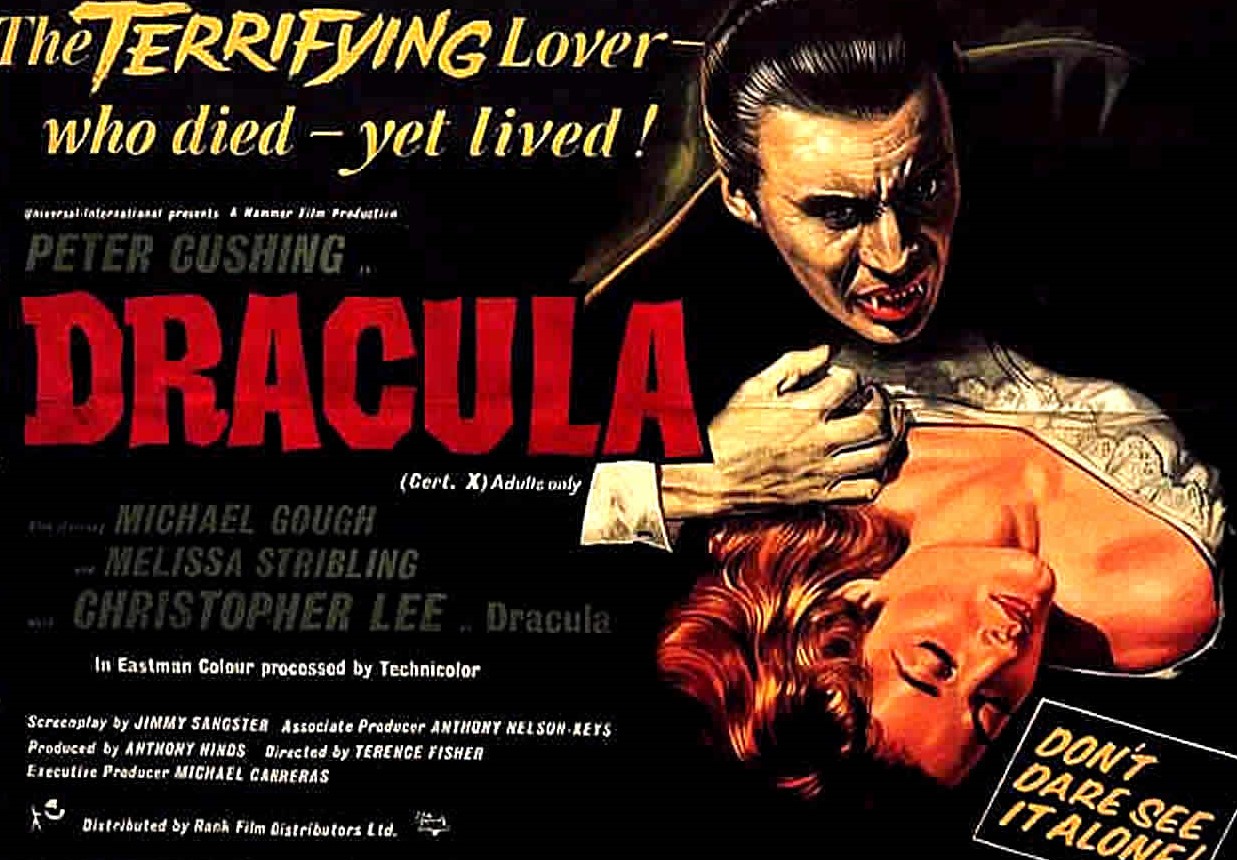
In Terence Fisher’s Horror of Dracula (1958), Count Dracula (Christopher Lee) has four distinct traits: deceiver, seducer, thief, and destroyer. A New Testament reading of the film makes him a Satan figure—the Devil in human form.
Dracula is a deceiver like the Devil: “a liar and the father of lies.”1 He escorts Jonathan Harker (John Van Eyssen) to his room, and when he leaves, he bolts the door, trapping him inside. Jonathan agreed to be Dracula’s librarian, but he is now a prisoner.
Dracula’s deceptions continue in London when he sends a message to Mina Holmwood (Melissa Stribling) to meet her husband at the undertaker. Her husband is elsewhere, and Dracula is waiting in the basement. He deceives Mina so he can drink her blood.
Sleeping in a coffin lined with dirt, the centuries-old vampire is literally a dirty old man who seduces women. A buxom brunette (Valerie Gaunt) lives in his castle as his bride, and he later seduces Lucy Holmwood (Carol Marsh). She lies on her bed like a bride on her wedding night, eagerly awaiting her groom. As Dracula hovers over her, the look on her face is an equal mixture of fear and delight, the same emotions a virgin might experience when she has sex for the first time. Transforming Lucy into a vampire is Dracula’s substitute for sex.
Beautiful women can’t resist the power of Dracula’s gaze, and they fall under his spell. After returning from a late-night rendezvous with the vampire, Mina greets her husband with a warm glow on her face, as if she just had sex. It is ironic that in draining Mina and Lucy of their life-giving blood, Dracula has reinvigorated them both as women. Yet not all women respond to him this way. When middle-aged Gerda (Olga Dickie) sees him, she says in horror, “he looked like the Devil!” Lucy and Mina are seduced by Dracula, but Gerda sees him for what he is: a figure of evil.
Dracula is the physical embodiment of Satan: “the thief [who] comes only to steal and kill and destroy.”2 Requiring human blood to survive, he steals the blood of Lucy and Mina. The idea of blood giving life to a vampire originates from the Old Testament when Moses commanded the Israelites, “You are not to eat the blood of any flesh, for the life of all flesh is its blood.”3 Dracula steals the blood of beautiful women to extend his life.
Dracula’s seduction of women has two principal aims: to drain them of their blood as a food source, and when they are drained dry, to turn them into vampires. Dracula destroys Lucy’s humanity, turning her into a monster, malevolent and evil like himself. Dracula’s destruction of Lucy’s humanity parallels Peter’s description of Satan who “prowls around like a roaring lion, seeking someone to devour.”4 When he ravishes Lucy, he appears like a lion with his long fangs and gaping mouth. Dracula is a human monster.
As a monster, Dracula is more than just a physical creature. He has supernatural power over his victims. Van Helsing (Peter Cushing) says Lucy has been “possessed and corrupted by the evil of Dracula.” Her transformation from human to vampire is like a demon possession that must be reversed. Van Helsing takes on the role of an exorcist, but instead of driving an evil spirit from Lucy’s body, he drives a stake through her heart, destroying her body to save her soul.
Dracula can be killed by driving a stake through his heart, but Van Helsing turns to the power of nature to destroy his adversary. He pulls down the curtain in the room, shining the light of the sun on the vampire, burning his flesh. This severely weakens him, yet he is ultimately destroyed by the power of the cross. As a supernatural being, Dracula is destroyed by supernatural power.
Dracula, as the Devil incarnate, is defeated by the power of Christ. Van Helsing says the crucifix “symbolizes the power of good over evil.” The crucifix becomes a symbolic representation of Christ, the Son of God who appeared “to destroy the works of the devil.”5 In the climax of the film, Van Helsing forms a cross with two pieces of metal and turns his enemy into dust. The final image of Dracula’s ashes scattered by the wind echoes God’s words to Adam: “for you are dust, and to dust you shall return.”6
Notes
1. John 8:44 (New American Standard Version).
2. John 10:10 (New American Standard Version).
3. Leviticus 17:14 (New American Standard Version).
4. 1 Peter 5:8 (New American Standard Version).
5. 1 John 3:8 (New American Standard Version).
6. Genesis 3:19 (New American Standard Version).
 Christopher Lindsay
Really excellent, Chris!
LikeLiked by 1 person