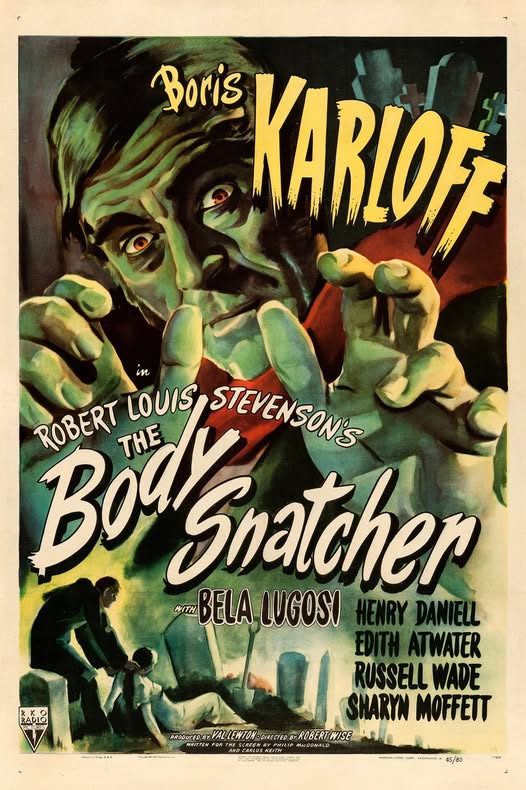

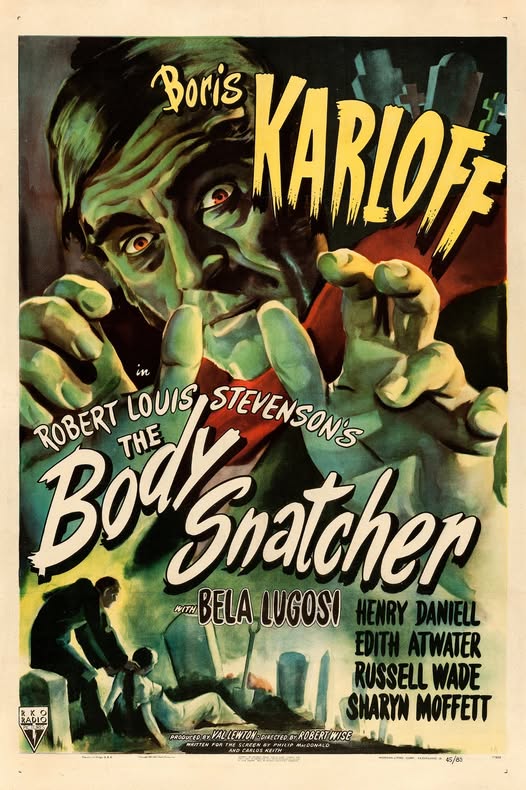
A protagonist can be defined as “the chief character in a plot, on whom our interest centers” (Abrams 293). In some films, there may be more than one protagonist. I will argue that the main protagonist can be identified by the following characteristics: the audience will care what happens to them, they often face an antagonist, they make decisions that move the plot forward, and they have a character arc.
In Robert Wise’s The Body Snatcher, it is debatable who the main protagonist is. There are two possibilities.
Fettes (Russell Wade) is the character the audience will identify with the most. For example, he is kind to Georgina Marsh, a girl who needs surgery. The son of a vicar, Fettes is a patient and compassionate man, and we identify with his positive traits.
While Fettes is likeable, it’s hard to identify with MacFarlane (Henry Daniell), or care what happens to him. He is temperamental, impatient toward Georgina and unwilling to perform surgery on her. He shows a softer side of his personality towards his wife, but throughout the film, his actions repel the audience.
In terms of facing an antagonist, MacFarlane opposes Gray (Boris Karloff) much more than Fettes. They are in conflict in every scene they appear together. In the second act climax, MacFarlane is in the ultimate conflict with Gray: a fight to the death.
Unlike MacFarlane, Fettes is not a threat to Gray. When Fettes learns that Gray murdered the street singer, he expresses his disapproval, but he does not go to the police. Fettes is ineffectual in opposing Gray.
Another way to identify the main protagonist is by the choices they make. Even if they begin as a passive character, they usually become active by the second act. Fettes is a passive protagonist throughout the film. For example, in the second act, he asks Gray for another body, and when Gray is noncommittal, Fettes leaves. He makes decisions, but he lacks the force of will to get what he wants.
Unlike Fettes, MacFarlane is an active protagonist, and his decisions move the plot forward. For example, in the first act, he hires Gray to rob graves for his research; in the second act, he murders him; and in the third act he decides to continue Gray’s work.
A final aspect of a protagonist is a character arc—they change by the end of the film. In a tragedy, the character arc of the protagonist is often negative. Even if they learn from their mistakes, they come to a bad end.
Fettes has an opportunity for positive change in the first act. After he discovers that Gray robbed a grave and killed a dog, he decides to leave the medical school. However, MacFarlane persuades him that graverobbing is necessary to gain “knowledge.” As a result, Fettes decides not to resign. He compromises his values and accepts that the ends justify the means.
Fettes descends further in the third act. He decides to resign, but he later assists MacFarlane in robbing a grave. Because Fettes failed the first act test and didn’t learn from it, he also fails the third act test and commits a crime. Fettes descends because of MacFarlane’s negative influence.
Although Fettes has a negative character arc for most of the film, MacFarlane has a greater descent. By the third act, MacFarlane has become like Gray: a graverobber and a murderer, and he has no regret or remorse. MacFarlane falsely reasons that murder will bring him peace.
According to J. Telotte, the final scene with Fettes leaving with his lamp suggests that “the cycle of grave robbings and murders in the name of science may be halted, that Fettes will not follow that path laid out by [MacFarlane]” (p.35). I agree with this interpretation, but Fettes has not changed as much as MacFarlane. His arc is positive—he is no longer deceived by false reasoning—but it is not significant character growth to realize that robbing graves is wrong. In the final scene, the superimposed quote states, “It is through error that man tries and rises. It is through tragedy he learns.” We can’t know with certainty what Fettes has learned, but now that MacFarlane is dead, he will chart a different course for his life.
Many viewers might see Fettes as the main protagonist because he is in the opening scene and the final shot. He is the character that the audience is rooting for. However, I would argue that MacFarlane is the main protagonist. He isn’t someone the audience identifies with, but he overcomes the antagonist, is more decisive than Fettes, and he changes the most, albeit in a negative way. MacFarlane is a tragic character who, despite his intelligence, doesn’t learn anything from his mistakes.
Works Cited
Abrams, M. H., and Geoffrey Harpham. A glossary of literary terms. Cengage Learning, 2015.
Telotte, J. P. “A Photogenic Horror: Lewton Does Robert Louis Stevenson.” Literature/Film Quarterly, vol. 10, no. 1, Jan. 1982, pp. 25–37. EBSCOhost, research.ebsco.com/linkprocessor/plink?id=e1d616bf-c6f2-3875-b1cb-bc528c38fead.
 Christopher Lindsay
Thank you, John, for your excellent comments and insights on Lewton.
Gray killed the street singer, so I would argue that makes him very much like Mr. Hyde.
LikeLike
I think that there’s some ambiguity as to who the main protagonist in The Body Snatcher is. Fettes strikes me as almost too young (for a protagonist! yes, in this story, as he lacks the experience, the knowledge and education, to bring about positive change), all things considered. Also, it was typical for Lewton to be confused (or ambivalent) as to who the bad guys and good guys really are in his pictures, so it’s MacFarlane for me, too. That aside, the good doctor, while he despises having to do business with the likes of cabman Gray, and he is, I agree, Gray’s moral superior, he lacks Gray’s fondness for children, disabled ones in particular. The cabman is a near Jekyll & Hyde sort, without the extreme diabolical aspects of Hyde. On a good day, he was nearer to Jekyll.
LikeLiked by 1 person